
Evolution in progress: The 28th Annual Salary and Expense Survey (2025)
by Gloria N. Hall and Allison M. Payne

—
Survey highlights and FAQs (click to expand)
Overall average billings were reported at $723,024, while average collections weighed in at $450,425.
The average DC salary was $106,586, while average total compensation was $141,601.
Office mortgage or rent was DCs’ biggest annual expense at an average of $30,819.
This year’s average reported chiropractic assistant salary was $41,192.
This year’s average reported licensed massage therapist salary was $34,314.
Yes. In 2025, DCs said 32% of their patients were Black, Hispanic or of color—a noticeable change from 27.5% in 2024 and 23% in 2023.
Yes. In 2025, 20% of DCs in this survey reported their practice was minority-owned, up from 15% in 2024 and 11% in 2023.
In this year’s survey, 37% of DCs reported working 31-40 hours per week.
Table of Contents (click to expand)
Table of contents
- Evolution in progress: The 28th Annual Salary and Expense Survey (2025)
- Introduction to the 2025 Salary and Expense Survey
- About the Salary and Expense Survey
- The typical DC profile
- Five years of Salary and Expense Survey data
- Billings and collections
- Patient payment patterns
- Solo DCs vs. group practices
- Spending patterns in solo and group practices
- Influence of integrative care
- How do you label your practice?
- Gender and money: Male DCs are still earning more
- In-practice product sales
- Regional roundup
- Getting older and hopefully richer
- Location, location, location
- Signing paychecks
- Minority report
- Specialist partnerships
- Final thoughts on the 28th Annual Salary and Expense Survey
- About the next Salary and Expense Survey
- The authors
- View previous years’ Salary and Expense Surveys
- References
Introduction to the 2025 Salary and Expense Survey
If you could pick one word to describe 2025 so far, “uncertain” seems to fit. And when you’re in business, any business, uncertainty isn’t desirable, especially when it applies to the economy, healthcare costs or your livelihood. So, we’d like to bring you one piece of great news the 2025 Salary and Expense Survey brings into focus: The chiropractic profession isn’t just surviving—it’s evolving, expanding and showing up in more places than ever before. And that’s a certainty.
From multidisciplinary and integrative teamwork to rising minority representation in both the chiropractic patient and practitioner populations, our annual survey suggests chiropractic is no longer an asterisk in the healthcare system, something “alternative” preferred by a small subset of patients.
Chiropractic has become business as usual, one of the options available in a market defined by both its huge size and dizzying number of choices, thanks to patient demand, data-driven practice models, evidence-based approaches and sheer persistence.
Look at where we were five years ago. In 2020, the coronavirus pandemic changed the entire healthcare landscape within weeks. It was the tipping point that caused many DCs to turn to telehealth to serve patients, using a combination of live visits and prerecorded video content to counsel them on exercise and other interventions. Telehealth combined with in-office precautions and adaptations, such as scheduling longer intervals between patients and using disinfection protocols and personal protective equipment (PPE), helped chiropractic make it through. Many patients, realizing the limitations of traditional healthcare’s emphasis on medicating symptoms, discovered chiropractic care during this time.
That momentum accelerated when the Chinese social site, TikTok, gained traction in the US and a DC named Joseph Cipriano went viral with videos of his now-infamous Y-strap adjustments. A real-life study of people’s fascination with the clips, published in the journal Cureus1 in January 2022, discovered that chiropractic adjustment videos were the most popular type of post in the healthcare category. These posts got potential patients talking, wondering about chiropractic and got many who would never have visited a DC visiting DCs.
During these years, stabilizing legitimacy happened in the form of some amazing research that validated several things DCs already knew: Chiropractic care is safe, effective and preferable to an opioid prescription for chronic pain. Based on recent research exploring chiropractic care’s efficacy and lack of adverse side effects, in 2023 the World Health Organization2 officially stated spinal adjustment was a viable, first-line intervention for low back pain.
Throughout the past five years, laws surrounding chiropractic care have slowly begun to shift, mostly at the state level, because that’s where licensing requirements are hammered out, but federally, too. The Chiropractic Medicare Coverage Modernization Act, which would bring more chiropractic services under Medicare’s coverage umbrella and allow seniors to see their DC for a wider range of health issues, failed in 2023, but returned to the forefront for a new legislative push in January 2025. States have been pushing for scope-of-practice updates, too. New York has such a bill in the works, and then there’s Montana, where a bill expanding DCs’ scope of practice has been knocked down several times but keeps rising again due to the efforts of a state representative from Billings who, himself a DC, seems to be persistence personified.
Read on for more insights into this year’s numbers, how they compare to last year’s and how they’ve shifted over the past five years.
About the Salary and Expense Survey
Our 28th Annual Salary and Expense Survey had 107 participants responding to an anonymous, confidential, web-based questionnaire. During February and March, Chiropractic Economics magazine invited practicing DCs (and CAs on their behalf) to complete the survey.
We extended the invitation by email as well as through announcements in our enewsletters, on our homepage and via our social networking sites. Additionally, we encouraged a number of state, national and alumni associations to distribute the survey to their members.

Regional representation
This year’s survey had participants from 28 states as well as a small percentage outside the US.
- South 41%
- Midwest 23%
- East 18%
- West 17%
- Outside US 1%
Note on survey methodology: Averages
You will find references to averages (or means) in this year’s survey; readers tell us they better understand the survey this way. We calculate averages by dividing the total by the number in the set—an arithmetic average.
The typical DC profile
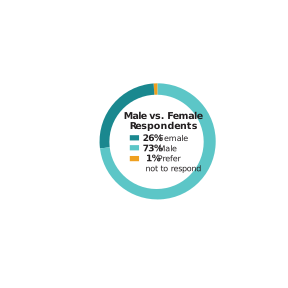
Our Salary and Expense Survey received responses from practitioners between the ages of 27 to more than 80 years old and from those in practice for a year or less to more than 50 years. By averaging the responses to many questions, we can see the typical DC in our survey is likely male (26% of respondents were female), 54 years old and a solo practitioner (57%) licensed in one state (74%). He owns one practice (78%) in the suburbs (59%), where he sees 138 patients a week, has a patient-visit average (PVA) of 34 and attracts seven new patients each week. He works a fairly traditional full-time schedule, seeing patients about 31-40 hours a week (37%). The practice bills an average of $723,024 annually and collects $450,425, for a reimbursement rate of 62%. Our typical DC pays chiropractic assistants a salary of $41,192 and himself $106,586, with an average total compensation of $141,601. He spends $30,819 per year on office leases or mortgages, $13,540 on advertising and $3,129 on malpractice insurance.
Tables: Overview of 2025 respondents
Table: Average income (click to expand)
| CATEGORY | AMOUNT |
|---|---|
| Billings | $723,024 |
| Billings range | $17K-5.1M |
| Collections | $450,425 |
| Collections range | $17K-3.2M |
| Reimbursement rate | 62% |
Table: Average salaries (click to expand)
| SALARY CATEGORY | AMOUNT |
|---|---|
| DC total compensation | $141,601 |
| Doctor of chiropractic | $106,586 |
| Associate DC | $88,348 |
| Chiropractic assistant | $41,192 |
| Nutritionist | $40,000 |
| Licensed massage therapist | $34,314 |
| Fitness trainer | $22,667 |
Table: Average expenses (click to expand)
| EXPENSE | AMOUNT |
|---|---|
| Office lease/mortgage | $30,819 |
| Business loan payments | $16,007 |
| Advertising/marketing | $13,540 |
| Business supplies | $11,701 |
| Computers/software | $7,529 |
| School loans | $7,098 |
| Continuing education | $3,887 |
| Malpractice insurance | $3,129 |
| Diagnostic services | $1,033 |
Five years of Salary and Expense Survey data
Our yearly number-crunching reveals consistent patterns that are much easier to see when you step back more than a year or two. The table on this page shows the past five years of survey data. It’s remarkably consistent, which you can take one of two ways: “We haven’t gotten very far” or “We’ve stayed remarkably steady given the healthcare environment.” Over the past five years, the profession has seen a notable shift toward suburban practice settings and toward solo ownership, after solo ownership had been waning. Patient volume appears to be stabilizing after a post-pandemic dip, with visits per week down from 171 in 2022 to 137 this year, even as new patient numbers begin to rebound. Despite fluctuating collections and compensation over the years, billings continue to climb, reaching their highest point yet at $723,024 this year. While total compensation has not returned to 2022’s peak, this year’s average of $141,601 suggests steady recovery, especially as average expenses remain relatively flat, except in one major category; more on that later in this article.
Table: DC information 2021-2025
Table: Five-year comparison of DC information (click to expand)
| PERSONAL CHARACTERISTICS | 2025 | 2024 | 2023 | 2022 | 2021 |
|---|---|---|---|---|---|
| Average age | 54 | 54 | 49 | 53 | 52 |
| Male | 73% | 76% | 75% | 71% | 75% |
| Female | 26% | 24% | 25% | 27% | 25% |
| Years in practice | 25 | 25 | 11 | 13 | 17 |
| Solo DC | 57% | 50% | 52% | 67% | 63% |
| Group/partnership with DCs | 18% | 23% | 26% | 23% | 22% |
| Multidisciplinary group | 8% | N/A | N/A | N/A | N/A |
| Integrated group | 5% | N/A | N/A | N/A | N/A |
| Associate DC | 3% | 12% | 17% | 9% | 10% |
| Franchise owner | 4% | 3% | 3% | 1% | 1% |
| PRACTICE CHARACTERISTICS | 2025 | 2024 | 2023 | 2022 | 2021 |
| Suburban | 59% | 54% | 56% | 57% | 54% |
| Urban | 25% | 29% | 26% | 29% | 31% |
| Rural | 16% | 14% | 18% | 14% | 15% |
| Number of employees (FT/PT) | 4 | 4 | 0-1 | 2.5 | 2.6 |
| Hours/week in patient care | 31-40 | 31-40 | 31-40 | 31-40 | 31-40 |
| Patient visit average | 34 | 37 | 60 | 61 | 60 |
| Patients/week | 138 | 111 | 154 | 171 | 168 |
| New patients/week | 7 | 10 | 8 | 10 | 9 |
| INCOME COMPARISONS | 2025 | 2024 | 2023 | 2022 | 2021 |
| Billings | $723,024 | $716,322 | $663,009 | $664,245 | $650,658 |
| Collections | $450,425 | $506,543 | $489,129 | $469,209 | $424,782 |
| DC salary | $106,586 | $99,327 | $120,389 | $132,565 | $102,444 |
| DC total compensation | $141,601 | $143,098 | $148,944 | $182,916 | $172,859 |
| AVERAGE EXPENSES | 2025 | 2024 | 2023 | 2022 | 2021 |
| Advertising/marketing | $13,540 | $9,457 | $16,512 | $11,802 | $10,005 |
| Malpractice insurance | $3,129 | $2,946 | $3,372 | $2,381 | $2,469 |
| Office lease/mortgage | $30,819 | $29,878 | $30,509 | $33,709 | $26,518 |
Billings and collections
Although DCs in our survey are billing for larger amounts, they are receiving a lower percentage of that money back than in 2024.
Average billings were reported at $723,024, an increase from $716,322 in 2024. Collections weighed in at $450,425, down from the $506,543 reported in 2024’s survey.
This year’s billings and collections numbers equal an average reimbursement rate of 62%, a drop from 71% in 2024.


Patient payment patterns
Each year, we ask how patients are actually paying for chiropractic care—and the latest responses continue to reflect a mixed-payment-instrument environment for DCs.
The average DC in our survey reported receiving:
- 56% of payments in cash
- 27% from insurance
- 16% from personal injury cases
- 9% from Medicare
- 4% from Medicaid
- 2% from workers’ compensation.
A handful of respondents, 1%, reported receiving payments through barter or trade. Although workers’ comp cases make up only a small portion of total payments in our results, state legislation underway may change that. In Oregon, for example, proposed legislation aims to simplify the process of DCs serving as treating physicians in workers’ comp cases. If such efforts succeed, we may see that 2% figure creep upward in future surveys.
Table: How patients pay for chiropractic care
Table: How patients pay for chiropractic care (click to expand)
| PAYMENT METHOD | PERCENTAGE |
|---|---|
| Cash | 56% |
| Insurance | 27% |
| Personal injury | 16% |
| Medicare | 9% |
| Medicaid | 4% |
| Workers’ compensation | 2% |
| Barter/trade | 1% |
Solo DCs vs. group practices
In 2025, the traditional distinction between solo and group practice models continues to evolve although solo practice remains dominant, with almost 57% of DCs saying they work independently—up from 50% last year.
Group arrangements of all kinds accounted for a growing number of responses, and we shifted our question structure to reflect the different ways DCs practice today. This year, 18% said they practice in a group or partnership with other DCs; 8% work in multidisciplinary clinics with other complementary practitioners and 5% are part of integrated practices (including MDs/DOs on staff). We had 3% report they work as associate DCs, 2% are hospital-based, and 2% work as independent contractors.
This more detailed breakdown provides clearer insight into how today’s DCs structure their work environments—and may help refine future discussions about compensation, overhead and collaboration.


Spending patterns in solo and group practices
Solo practices spent an average of $2,374 on malpractice insurance in 2025, down slightly from $2,397 in 2024. They also reported spending $8,154 on advertising and marketing—nearly double last year’s $4,321.
Group practices (including DCs in partnership with each other, integrated and multidisciplinary practices) spent $4,927 on malpractice insurance this year, up somewhat from $4,397 in 2024. Advertising spend also increased, with group practices averaging $27,927, compared to $22,102 last year.
When it comes to real estate, group practices reported spending $55,522 on office space, up from $46,638 the previous year. Solo practices spent $18,819, down from $22,346 in 2024.
Why the rise in advertising dollars spent? A few forces may be at play. As more DCs branch into multidisciplinary and integrative care, solo practitioners may be ramping up their marketing efforts to emphasize what sets them apart. At the same time, with average new patient counts down, many DCs may simply be spending more to acquire each new patient lead. Add to that the rising cost of paid digital advertising, the lower visibility of organic social posts and the growing popularity (and expense) of influencer marketing and video content, and the jump in spending starts to make sense.
Table: Solo vs. group practices
Table: Comparison of solo and group practices (click to expand)
| PRACTICE LABEL | SOLO | GROUP* |
|---|---|---|
| Clinic | 65% | 75% |
| Wellness center | 13% | 12.5% |
| Rehab center | 4% | 7% |
| Other | 15% | 3% |
| PRACTICE AVERAGES | SOLO | GROUP* |
| Number of employees (FT/PT) | 2 | 8 |
| Patient visit average | 35 | 37 |
| Patients/week | 91 | 242 |
| New patients/week | 5 | 10 |
| Cash-based | 35% | 31% |
| Billings | $373,727 | $1,393,228 |
| Collections | $269,303 | $841,684 |
| AVERAGE SALARIES | SOLO | GROUP* |
| Associate DC | $55,000 | $91,158 |
| Chiropractic assistant | $34,167 | $49,176 |
| Licensed massage therapist | $25,986 | $38,250 |
| Doctor of chiropractic | $89,007 | $136,300 |
| DC total compensation | $113,420 | $192,726 |
| SPECIALISTS PROVIDED | SOLO | GROUP* |
| Acupuncturist | 4% | 7% |
| Fitness trainer | 2% | 7% |
| Licensed massage therapist | 17% | 50% |
| Medical doctor/doctor of osteopathy | 0% | 11% |
| Nurse/nurse practitioner | 2% | 7% |
| Nutritionist | 0% | 3% |
| Physical therapist | 0% | 0% |
| None | 75% | 13% |
| AVERAGE EXPENSES | SOLO | GROUP* |
| Office lease/mortgage | $18,819 | $55,522 |
| Advertising/marketing | $8,154 | $27,927 |
| Malpractice insurance | $2,374 | $4,947 |
Comparison of solo and group practices | 2025 Chiropractic Economics Salary and Expense Survey
Influence of integrative care
This year, we looked more deeply into the differences between clinic types: DC-only, integrated and multidisciplinary practices.
A DC-only practice includes solo DCs and those in partnership with other DCs. An integrated clinic is defined as one that includes both a DC and an MD or other doctor-level practitioner, such as a nurse practitioner or physician assistant, on staff. A multidisciplinary clinic includes a DC alongside other complementary practitioners, such as acupuncturists, physical therapists and licensed massage therapists.
In 2025, 57% of respondents identified as DC-only, 18% identified as group/partnership with other DCs, 8% operated in a multidisciplinary practice setup and 5% practiced as part of integrated groups.
Integrated practices reported the highest billings at $2,180,083, followed by multidisciplinary practices at $785,000 and DC-only practices at $373,727.
Likewise, integrated practices collected the most at $856,667, followed by multidisciplinary practices at $650,286 and DC-only practices at $269,303.
While integrated practices led in billings and collections, they reported the lowest DC total compensation among the three models. In 2025, DC-only practices, including those working solo and in partnership with other DCs, earned an average salary of $100,226 and total compensation of $140,640.


How do you label your practice?
Every year, we ask DCs how they label their practice. While responses vary, most fall into a few recognizable categories.
In 2025, 67% of respondents identified their practice as a “clinic,” a slight drop from 71% in 2024. Another 14% described their office as a “wellness center,” down from 20% last year. The number of practices identifying as “rehab centers” had a decline to 3%, from 6% in 2024. The term “medical spa” got a zero-percent response this year.
Almost 13% answered “other,” and those responses showed a trend toward labeling practices in a way more specific to their niche, such as “integrative sports medicine clinic,” “virtual functional nutrition” or “independent traveling electromyographer.” A couple of respondents noted their practices were mobile chiropractic setups, a trend we’ll dig into in future surveys.
Table: Practice characteristics by type
Table: Practice characteristics by type (click to expand)
| PRACTICE LABEL | SOLO DCs | GROUP DCs | MULTIDISCIPLINARY | INTEGRATED |
|---|---|---|---|---|
| Clinic | 67% | 79% | 75% | 60% |
| Wellness center | 14% | 16% | 13% | 0% |
| Rehab center | 3% | 5% | 13% | 20% |
| PRACTICE LOCATION | SOLO DCs | GROUP DCs | MULTIDISCIPLINARY | INTEGRATED |
| Urban | 17% | 32% | 25% | 40% |
| Suburban | 62% | 63% | 63% | 40% |
| Rural | 21% | 5% | 13% | 20% |
| PRACTICE STATISTICS | SOLO DCs | GROUP DCs | MULTIDISCIPLINARY | INTEGRATED |
| Number of employees (FT/PT) | 2 | 10 | 7 | 7 |
| Patient visit average | 35 | 41.5 | 15 | 59 |
| Patients/week | 91 | 270 | 164 | 203 |
| New patients/week | 5 | 10 | 11 | 10 |
| Cash-based | 35% | 37% | 25% | 20% |
| AVERAGE EXPENSES | SOLO DCs | GROUP DCs | MULTIDISCIPLINARY | INTEGRATED |
| Office lease/mortgage | $18,819 | $57,625 | $60,000 | |
| Advertising/marketing | $8,154 | $21,760 | $23,000 | * |
| Malpractice insurance | $2,374 | $5,869 | $3,450 | $3,333 |
| AVERAGE SALARIES | SOLO DCs | GROUP DCs | MULTIDISCIPLINARY | INTEGRATED |
| Associate DC | $55,000 | $85,714 | $100,500 | $130,000 |
| Chiropractic assistant | $34,167 | $40,750 | $53,808 | $38,000 |
| Licensed massage therapist | $25,986 | $41,667 | $36,800 | $25,000 |
| Doctor of chiropractic | $89,007 | $131,389 | $124,857 | $170,000 |
| DC total compensation | $113,420 | $214,294 | $194,600 | * |
| Billings | $373,727 | $1,511,792 | $785,000 | $2,180,083 |
| Collections | $269,303 | $922,611 | $650,286 | $856,667 |
Gender and money: Male DCs are still earning more
In 2025, 26% of our survey respondents were women, up slightly from 24% in 2024. We’ve seen variations in female participation over recent years, but that number has never risen beyond an all-time high of 28% in 2020. Our survey consistently reflects an approximate 75/25 gender split that also persists in the practicing DC population at large, though that breakdown has slowly shifted away from the 80/20 ratio that was the norm for many years. And we have good news on the academic front: Chiropractic schools are rapidly closing the gender gap in the industry and starting to see enrollments very close to a 50-50 split—for example, Palmer College of Chiropractic reported in 2024, its enrollment was 45% female.3 These results suggest an overall positive trend toward gender balance in the profession—if you’re talking about numbers of women and numbers of men. If you’re talking dollars in bank accounts, a large, persistent income gap remains. Female DCs reported an average salary of $64,393, a significant drop from $84,077 in 2024. Their total compensation also decreased, falling to $87,706 from $122,464 the year before. Male DCs reported a 2025 average salary of $124,749, up from $102,033 in 2024. Their total compensation was $156,451, also up from $150,559 the previous year.
Time female DCs spent in patient care
- 31% reported working 31–40 hours per week
- 38% said they worked 21–30 hours
- 15% reported 11–20 hours
Notably, 12% of women said they spent only 1–10 hours per week in patient care. Among male DCs, 38% worked 31–40 hours, 25% worked 21–30 hours, and 19% worked 41 or more.
So, is it hours worked that accounts for the gap in pay? Even though hours don’t translate directly to income, especially for practice owners, this may be a factor. Only about 4% of women in this survey saw patients more than 40 hours per week, versus 19% of men. We don’t have data on time spent per patient encounter—though we might add it in future surveys.
A gender-based pay gap exists for medical doctors, too, with recent research looking into potential causes. According to a 2020 study in the New England Journal of Medicine,4 “the differences in time spent with patients may be a contributor to the gender pay gap, with female physicians effectively generating 87% of what male physicians generate.”
Female primary care physicians spent 16% more time with each patient than their male counterparts, even after researchers accounted for factors like patient gender and visit complexity. That translates to about 2.4 minutes more per patient—which adds up.
Other research has suggested female physicians may take more thorough patient histories and provide more detailed explanations of procedures and diagnoses, further explaining the pay discrepancy.


In-practice product sales

Chiropractic Economics Salary and Expense Survey
Nearly 75% of DCs in our survey sell at least one product in their practice. This consistently high percentage underscores how retail remains a reliable source of supplemental income for many chiropractic offices—and a valuable extension of patient care.
We asked respondents about the products they offer.
Top seven retail products for DCs
- Nutritional products/supplements: 48%
- Hot/cold compresses: 39%
- Pillows: 37%
- Topical creams/ointments: 36%
- Durable medical equipment (braces/supports): 33%
- Orthotics: 29%
- Herbal products: 25%
Regional roundup
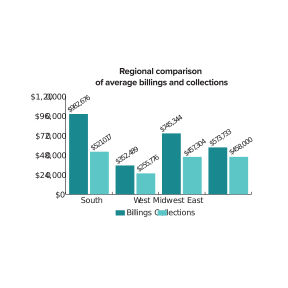
DC total compensation for 2025 varied widely by geography; some figures increased and some decreased since last year.
DC total compensation by region
- Midwest: $134,266 (vs. $129,920 in 2024)
- West: $64,532 (vs. $105,641 in 2024)
- East: $138,867 (vs. $113,975 in 2024)
- South: $169,767 (vs. $182,490 in 2024)

—
Getting older and hopefully richer
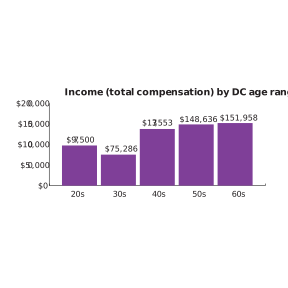
Your DC compensation should increase as you grow older and gain experience—and for the most part, this year’s survey supports that expectation. In 2025, DCs in their 20s earned an average of $97,500; 30s, $75,286; 40s, $137,553; 50s, $148,636 and 60 and older, $151,958.
This breakdown closely mirrors our results in 2024, including the sharp drop during the 30s. We initially thought that dip was an anomaly when it appeared in last year’s data but seeing it again this year suggests consistent contributing factors. Many DCs in their 30s are still paying off student loans, transitioning from associate roles to ownership or starting families, any of which could impact hours worked or income. They may also still be mid-practice-launch, building patient flow or managing rising overhead without having hit their financial stride yet.


Location, location, location
With more available retail space, a growing patient base and often lower overhead, the suburbs remain a popular place for DCs to operate a practice. This year, as expected in our survey, 59% of respondents practiced in suburban areas (vs. 54% in 2024), 25% practiced in urban areas (vs. 29% in 2024) and 16% practiced in rural areas (vs. 14% in 2024).
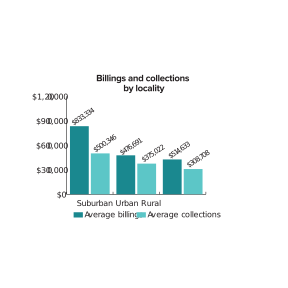
Suburban DCs once again reported the highest average salary at $121,360, while urban doctors reported an average of $79,806, and rural doctors earned $94,200.
Billings and collections also varied by setting: Suburban practices billed $833,334 and collected $500,346 (reimbursement rate: 60%). Urban practices billed $476,681 and collected $375,022 (reimbursement rate: 79%) and rural practices billed $514,633 and collected $308,708 (reimbursement rate: 60%).


Signing paychecks
Behind every successful chiropractic office is a dedicated support team—and that team doesn’t come free. In this year’s survey, we asked DCs what they’re paying the people who help keep their practices in business.
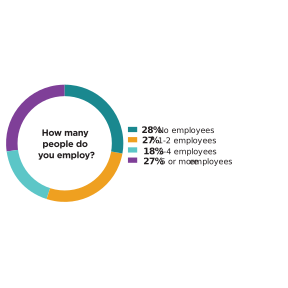
In 2025, 28% of DCs said they have no employees. About 27% employ one or two people, 18% employ three or four, and 27% report having five or more employees. That averages out to four employees per DC, typically two part-time and two full-time.
Average employee salaries
- Associate DC: $88,348 (vs. $48,739 in 2024)
- Chiropractic assistant: $41,192 (vs. $34,983)
- Licensed massage therapist: $34,314 (vs. $17,807)
Minority report
While more and more people are learning about and embracing chiropractic care and its non-drug approach to pain management, research continues to show disparities in access. Patients who are Black, Hispanic or of color may not seek care from a DC at the same rate as white patients—often due to complex, interwoven factors such as financial status, education level, neighborhood safety, transportation and provider access.
Like last year, we have good news to report. In 2025, DCs said 32% of their patients were Black, Hispanic or of color—a noticeable change from 27.5% in 2024 and 23% in 2023. This suggests that efforts to expand access and awareness in underserved communities are showing results.
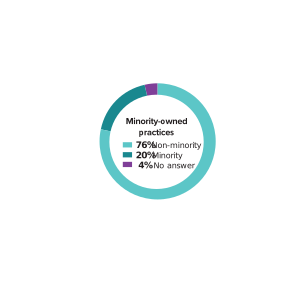
Although the number of DCs of color lags behind, this year 20% of respondents reported their practice was minority-owned, up from 15% in 2024 and 11% in 2023.
Table: Modalities offered
Table: Modalities offered (click to expand)
| MODALITY | DCs WHO OFFER IT |
|---|---|
| Instrument adjusting | 61% |
| Exercise program | 53% |
| Flexion distraction | 46% |
| Nutrition advice | 41% |
| Kinesiology taping | 41% |
| Laser therapy for pain relieft | 40% |
| Electrotherapy | 40% |
| Stim/ultrasound | 40% |
| Instrument assisted soft tissue mobilization | 35% |
| Physical therapy/rehab therapy | 31% |
| Massage therapy | 31% |
| Decompression | 28% |
| Cupping | 25% |
| Cryotherapy | 20% |
| Flossing | 17% |
| Dry needling | 17% |
| Shockwave/vibration therapy | 16% |
| Acupuncture | 16% |
| Functional medicine | 15% |
| Red light therapy for pain relief | 14% |
| Weight management | 13% |
| Fitness devices | 9% |
| Pulsed electromagnetic field therapy | 7% |
| Medical services | 6% |
| Red light therapy for weight/fat management | 5% |
| Homeopathy | 5% |
| Neurofeedback | 3% |
| Laser therapy for weight/fat management | 3% |
| Dry hydrotherapy | 3% |
| Violet wave therapy | 2% |
| Thermography | 1% |
| TECAR therapy | 1% |
| Stem cell therapy | 1% |
Specialist partnerships
Year after year, our data shows DCs who collaborate with other healthcare professionals tend to see stronger patient volume, higher revenue and better compensation. In 2025, that pattern continued.
This year, 53% of DCs reported having other specialists working in or consulting with their practice. These included licensed massage therapists (LMTs), physical therapists (PTs), acupuncturists, fitness trainers, nutritionists, medical doctors (MDs), doctors of osteopathy (DOs) and nurse practitioners.
Differences in performance between practices with and without specialists were significant. Practices with specialists averaged 204 patients per week, nearly three times the volume seen by practices without specialists, which averaged 63 patients per week.
Billings and collections followed a similar pattern. Practices with specialists brought in $1,047,322 in billings and $657,130 in collections, while those without specialists averaged $214,957 in billings and $143,499 in collections.
Doctors of chiropractic in specialist-supported practices also reported significantly higher earnings. Their average salary was $123,291, and their total compensation reached $175,085—compared to $84,313 in salary and $93,469 in total compensation for DCs working without specialists.
Tables: Specialists in chiropractic practices
Table: Specialists employed by DCs (click to expand)
| SPECIALIST | PERCENTAGE OF DCs WHO EMPLOY |
|---|---|
| No specialists | 48% |
| Chiropractic assistant | 35% |
| Licensed massage therapist | 25% |
| Associate DC | 20% |
| Acupuncturist | 5% |
| Medical doctor or doctor of osteopathy | 5% |
| Nurse or nurse practitioner | 4% |
| Fitness trainer | 3% |
| Licensed massage therapist | 3% |
| Physical therapist | 1% |
Table: How specialists boost your income and affect expenses (click to expand)
| AVERAGE SALARIES | SPECIALISTS | NO SPECIALISTS |
|---|---|---|
| Associate DC | $88,955 | $75,000 |
| Chiropractic assistant | $42,130 | $32,750 |
| Licensed massage therapist | $34,314 | N/A |
| Doctor of chiropractic | $123,291 | $84,313 |
| DC total compensation | $175,085 | $93,469 |
| AVERAGE EXPENSES | SPECIALISTS | NO SPECIALISTS |
| Office lease/mortgage | $47,721 | $10,220 |
| Advertising/marketing | $20,579 | $4,891 |
| Malpractice insurance | $4,029 | $2,083 |
Final thoughts on the 28th Annual Salary and Expense Survey
Five years ago, the numbers in our Salary and Expense Survey looked a lot like they do now—but the context has shifted dramatically. Chiropractic care is showing up in more conversations, more integrated clinics and more legislative agendas. Progress isn’t always loud, but it’s unmistakable: Average billings are up, minority access is growing and DCs are expanding and diversifying their practice models without losing their focus on personalized patient care.
About the next Salary and Expense Survey
Chiropractic Economics is here to serve you, today’s doctor of chiropractic, with the real-world, expert advice you need to succeed in business, and this survey is one big part of that goal. We’re making some exciting changes to our surveys over the coming year, adding questions about the latest developments in chiropractic care, such as AI integration, and giving our results presentation an interactive overhaul.
We invite you to download these survey results in graphic format and use the statistics, free of charge, for your marketing and social content. You can also sign up to be one of the first to receive the next survey in your inbox, along with special offers to redeem when you send it to your colleagues or share it with your own mailing list. We know your time is valuable, so we’re doing everything we can to make our survey process faster, more interesting and most of all, rewarding. We couldn’t do it without you!
The authors
GLORIA N. HALL is the editor-in-chief of Chiropractic Economics.
ALLISON M. PAYNE is the associate editor of Chiropractic Economics.


