


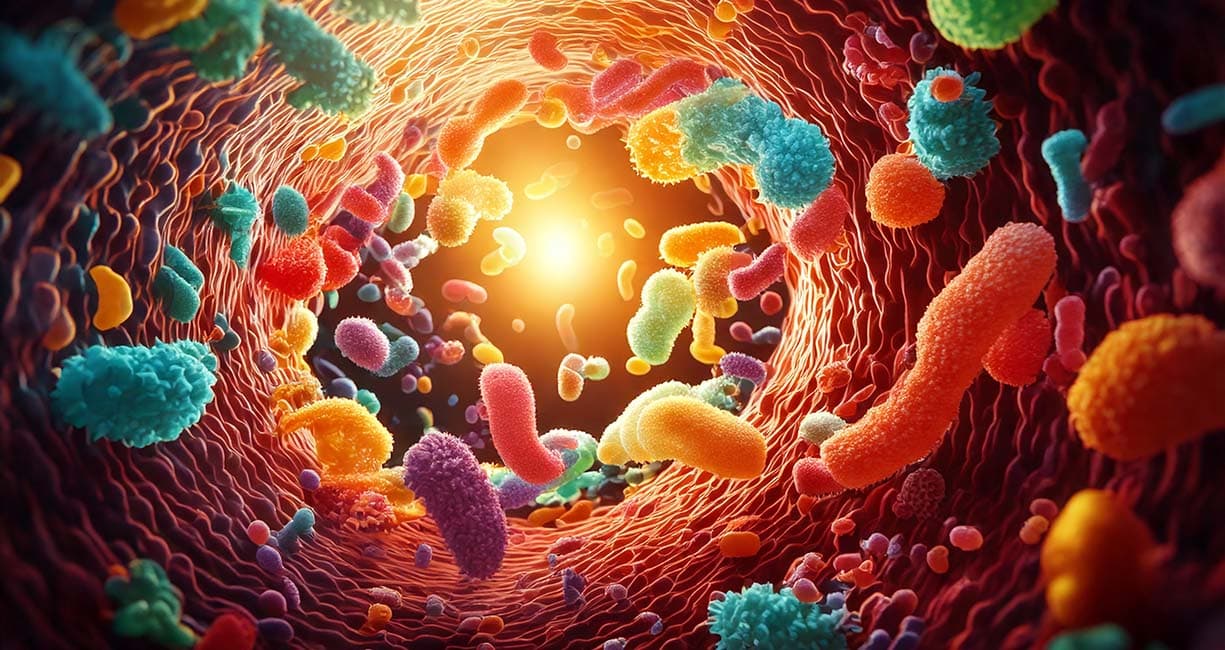
Synbiotic supplementation is required for optimum immune system balance.
The lining of your alimentary canal is fully equipped as your first line of defense against microbial pathogens.
However, the critical essence of the immune cell presence in the gut is its effects extending far beyond the gut, exercising control over all aspects of systemic immune responses. Do you marvel that immune cells use the gut lining as their home base, from which they are commanded by microbiota to mobilize in combat against immune system stress assaults on any tissue? Truly, it is the power of the intestinal microbiota that commands both activation and inhibition of dendritic cells, macrophages, mast cells and eosinophils in the gut lining.1,2,3,4,5
Your microbiota is the “major general” of your immune system forces
The benefits of a healthy microbiota include:

- Initiating either the release or inhibition of pro-inflammatory cytokines2,4
- Initiating either the release or inhibition of anti-inflammatory cytokines2,4
- Activating or inhibiting billions of mast cells, the most fundamental component of the innate immune response4,5
- Connecting the immune system to the nervous system, as mast cells cluster around sympathetic and parasympathetic nerve endings in the gut wall4,5
- Activating anti-inflammatory functions of the vagus nerve6
- Responding with an alarm reaction to the toxins produced by abnormal bacteria, fungi, yeast or viruses in the GI tract; triggering the release of pro-inflammatory cytokines in defense7
The microbiota controls the enteroendocrine cells communicating with a broad array of immuno-neuro-endocrine functions. The communication network includes the gut-liver axis, the gut-brain axis, the gut-hypothalamus axis, the gut-adipose axis and the gut-pancreas axis. However, the overarching influence of the microbiota is via the gut-immune axis.
The microbiota-gut-immune system axis
Researchers have identified a select group of probiotics that are essential, not only for gut health, but for a highly responsive yet thoroughly controlled and balanced systemic immune system. One specific component of immune system balance is the antagonism/balance between lymphocytic T-helper cell-1 (Th1) and T-helper cell-2 (Th2) function. The Th1 inflammatory cytokine family includes interferon-γ (IFN-γ), tumor necrosis factor-α (TNF-α) and interleukins (IL) 1, 2, 8 and 12. Th2 inflammatory cytokines include the pro-inflammatory IL-5, 6 and 13, along with the anti-inflammatory IL-4 and 10. Deficiency in either family of Th1 or Th2 cytokines is characteristic of both acute and chronic inflammatory processes. But more significant than deficiencies of these inflammatory cytokines are uncontrolled excesses.2,4,5,8,9,10,11
Uncontrolled immune reactivity of Th1 inflammatory cytokines is typical of chronic auto-immune diseases such as rheumatoid arthritis, Crohn’s disease, Type 1 diabetes and multiple sclerosis. Dysregulated Th2 reactivity, often accompanied by a deficiency of Th1 immune system defense, is characteristic of immunoglobulin-E-mediated allergies, with elevated eosinophil and mast cell reactivity, along with other histamine-mediated reactions and asthma.2,4,5,8,9,10,11
Synbiotic supplementation, which combines probiotics and prebiotics, is required for optimum immune system balance, assuring a decreased capacity to cause deviation of inflammatory response toward systemic, Th1- and Th2-activated pathology.1,3,9,10,12
Specificity in probiotic supplementation
In patients with a proclivity toward either Th1- or Th2-dominant health problems, you must be selective in probiotic supplementation. To do otherwise is to potentially exacerbate inflammatory symptoms and intensify the processes of inflamm-aging.
The probiotic species most immune-reactive in humans can be divided into two “teams.” One team strongly inhibits excessive Th1 inflammatory cytokines, and to a certain extent helps activate the anti-inflammatory Th2 cytokines. That team includes L. reuteri, B. breve and B. longus. The probiotics controlling Th2 inflammation while strengthening a weak Th1 defense include L. rhamnoses, L. casei and L. gasseri.2,5,7
To supplement in accord with every patient’s specific needs, you must be particular in recommending probiotics suitable for the individual’s tendency to be either Th1- or Th2-dominant in immune system reactivity.
In consideration of patients with high Th1 and low Th2 reactivity
- L. reuteri reduces the production of pro-inflammatory cytokines in dendritic cells. Research shows it is perhaps the most powerful anti-inflammatory of all probiotics.4,8-10,14
- L. gasseri induces high levels of Th1 inflammatory IFN-γ, and a low level of Th2 anti-inflammatory IL-10. In contrast, L. reuteri activates anti-inflammatory IL-10. Which should you choose for your ulcerative colitis patient? Your better choice is to carefully avoid the Th1-activating probiotics in this auto-immune condition.8-11
- L. reuteri induces the expression of a stress-inducible enzyme with antioxidant and anti-inflammatory properties.9
- L. reuteri primes monocyte-derived dendritic cells to drive the development of T cells. These T cells produce increased levels of anti-inflammatory IL-10. L. reuteri binds C-type lectin of dendritic cells. This targeting of dendritic cells by L. reuteri explains its beneficial effect in the treatment of Th1-mediated inflammatory diseases, including atopic dermatitis and Crohn’s disease, as well as its benefit in increasing bone density.8,9,13,14,15
- Research suggests L. reuteri is effective for down-regulating production of IL-12 and TNF-α, while inducing the anti-inflammatory IL-10, thus representing an effective anti-inflammatory therapy in all Th1-mediated autoimmune diseases.8-11
- B. breve produces peripheral blood mononuclear cell release of the Th2 anti-inflammatory IL-10. It is one of the three probiotics shown to skew immune reactivity away from Th1-mediated inflammation toward anti-inflammatory Th2 cytokines.1,2
- In human monocyte-derived dendritic cells, L. rhamnosus increases Th1 inflammatory TNF-α. It is not a good choice for your rheumatoid arthritis patients.
- L. rhamnosus should not be given to patients with Crohn’s disease or other Th1-driven inflammatory conditions. In contrast, beneficial effects of the inhibition of IFN-γ and TNF-α production by B. breve, may result in an ideal tolerant state, with decreased Th1 immune responses, while other immune pathways remain intact. Such balance sustains immune competence of the host. Supplementation thus offers an alternative to immune-suppressing drugs that impair immune defense. B. breve is therefore an extremely effective probiotic for patients with inflammatory conditions.
- Probiotics that attenuate IBD are those that down-regulate Th1 cytokines while maintaining TGF-β.
- In humans suffering from autoimmune ulcerative colitis, the Bifidobacteria population is about 30-fold lower compared to that in healthy individuals. Supplementation of ulcerative colitis patients with oligofructose-enriched inulin as a prebiotic, together with B. longum for one month, results in a 42-fold increase in Bifidobacteria.4,5,8,9,13,14,15
- Th2 anti-inflammatory IL-10 production is induced by B. breve and B. longum. These Bifidobacterial species, along with L. reuteri, are among the few probiotics that induce a Th2-driven immune response.8-10
Probiotics considerations for patients with high Th2 and low Th1 reactivity
- L. rhamnosus induces a significant Th1 response in peripheral monocytes by significantly increasing IFN-γ, TNF-α and IL-1-β. It also, however, induces significant activation of IL-10, a TH2 anti-inflammatory cytokine.16,17,18,19
- In human macrophages, L. rhamnosus activates NF-KappaB, a powerful protector against stress, inflammatory cytokines, free radicals, heavy metals, UV radiation, oxidized LDL cholesterol, and of course, viral and bacterial infection.4,16
- L. casei induces the release from peripheral blood mononuclear cells of moderate amounts of IFN-γ, TNF-α, IL-1-β and IL-6, which is critical to anti-microbial immune defense.18-21
- L. rhamnosus stimulates rotorvirus-specific IgA antibody responses, which are significant in the prevention of reinfections.20
- L. rhamnosis and L. casei are shown to inhibit the secretion of Th2 cytokines IL-4 and IL-5. The mechanism is dependent on antigen-presenting cells (i.e., monocytes/macrophages/dendritic cells), and involves the release of Th1 cytokines IL-12 and IFN-γ. These benefits are effective in the control of asthma and histamine-mediated allergies.18-21
- L. casei increases the activity of enzymes from macrophages six-fold. There is also a beneficial effect of L. casei on the phagocytic function of the reticuloendothelial system.18-21
- L. casei exhibits marked anti-tumor activity. Research suggests that anti-tumor activity may be macrophage-dependent.22
- It is also reported that natural killer cell activity is augmented by L. casei.23
Final thoughts on synbiotic supplementation
When you consider the concept of microbiota specificity, it is imperative you offer synbiotic supplementation in accordance with all patients’ specific needs, helping them battle inflammation with a powerfully mobilized microbiota.
Guy R. Schenker, DC, a Pennsylvania doctor of chiropractic since 1978, is the developer of the Nutri-Spec System of Clinical Nutrition, which eschews symptom-based nutrition in favor of individualized metabolic therapy. Nutri-Spec offers a Stage of Life Diphasic Nutrition Plan (SOLID DNP) empowering each patient to Live Stronger Longer. Schenker can be reached at 800-736-4320 or nutrispec@nutri-spec.net.
References
- Wiertsema S, et al. The interplay between the gut microbiome and the immune system in the context of infectious diseases throughout life and the role of nutrition in
optimizing treatment strategies. Nutrients. 2021;13(3):886. PubMed. https://pubmed.ncbi.nlm.nih.gov/33803407/. Accessed March 17, 2025. - Huihui X, et al. The dynamic interplay between the gut microbiota and autoimmune diseases. J Immunol Res. 2019:2019:7546047. PubMed. https://pubmed.ncbi.nlm.nih.gov/31772949/. Accessed March 17, 2025.
- Human Microbiome Project Consortium. A Framework for Human Microbiome Research. Nature. 2012. Research Gate. https://www.researchgate.net/publication/230635491_A_framework_for_human_microbiome_resea. Accessed March 17, 2025.
- Traina G. The role of mast cells in the gut and brain. J. Integr Neurosci. 2021;20(1):185-196. PubMed. https://pubmed.ncbi.nlm.nih.gov/33834706/. Accessed March 17, 2025.
- Raffaella di Vito, et al. The cross-talk between intestinal epithelial cells and mast cells is modulated by the probiotic supplementation in co-culture models. Int J Mol Sci.2023;24(4):4157. PubMed. https://pubmed.ncbi.nlm.nih.gov/36835568/. Accessed March 17, 2025.
- Bonaz B, et al. The vagus nerve at the interface of the microbiota-gut-brain axis. Front Neurosci. 2018:12:49. PubMed. https://pubmed.ncbi.nlm.nih.gov/29467611/. Accessed March 17, 2025.
- Zhou L, et al. Innate lymphoid cells support regulatory T Cells in the intestine through interleukin-2. Nature. 2019;568(7752):405-409. PubMed. https://pubmed.ncbi.nlm.nih.gov/30944470/. Accessed March 17, 2025.
- Wang W, et al. Inflammatory response: A crucial way for gut microbes to regulate cardiovascular diseases. Nutrients. 2023;15(3):607. PubMed. https://pubmed.ncbi.nlm.nih.gov/36771313/. Accessed March 17, 2025.
- Smits HH, et al. Selective probiotic bacteria-induced IL-10-producing regulatory T cells in vitro by modulating dendritic cell function through dendritic cell-specific intercellular adhesion molecule 3-grabbing nonintegrin. J Allergy Clin Immunol. 2005;115(6):1260-1267. PubMed. https://pubmed.ncbi.nlm.nih.gov/15940144/. Accessed March 17, 2025.
- He B, et al. Resetting microbiota by Lactobacillus reuteri inhibits t reg Deficiency-induced Autoimmunity via Adenosine A2A Receptors. J Exp Med. 2017;214(1):107-123. PubMed. https://pubmed.ncbi.nlm.nih.gov/27994068/. Accessed March 17, 2025.
- Harata G, et al. Differential implication of lactobacillus GG and L gasseri TMC0356 to immune responses of murine peyer’s patch. Microbiol Immunol. 2009;53(8):475-480. PubMed. https://pubmed.ncbi.nlm.nih.gov/19659932/. Accessed March 17, 2025.
- He B, et al. Lactobacillus reuteri reduces the severity of experimental autoimmune and encephalomyelitis in mice by modulating microbiota. Front Immunol. 2019:10:385. PubMed. https://pubmed.ncbi.nlm.nih.gov/30899262/. Accessed March 17, 2025.
- Collins FL, et al. Beneficial effects of Lactobacillus reuteri on bone density in male mice is dependent on lymphocytes. Sci Rep. 2019;9(1):14708. PubMed. https://pubmed.ncbi.nlm.nih.gov/31605025/. Accessed March 17, 2025.
- Jiri H, et al. Lactobacillus reuteri and bifidobacterium animalis lactis improved colitis while differentially impacting dendritic cell maturation and antimicrobial responses. Sci Rep. 2020;10(1)5345. PubMed. https://pubmed.ncbi.nlm.nih.gov/32210304/. Accessed March 17, 2025.
- Hoarau C, et al. Supernatant of bifidobacterium breve induces dendritic cell maturation, activation, and survival through a toll-like receptor 2 pathway. J Allergy Clin Immunol. 2006;117(3):696-702. PubMed. https://pubmed.ncbi.nlm.nih.gov/16522473/. Accessed March 17, 2025.
- Spacova I, et al. Lactobacillus rhamnosus probiotic prevents airway function deterioration and promotes gut microbiome resilience in a murine asthma model. Gut Microbes. 2020;11(6):1729-1744. PubMed. https://pubmed.ncbi.nlm.nih.gov/32522072/. Accessed March 17, 2025.
- Li L, et al. Prophylactic effects of oral administration of Lactobacillus casei on house dust mite-induced asthma in mice. Food Funct. 2020;11(10):9272-9284. PubMed. https://pubmed.ncbi.nlm.nih.gov/33047743/. Accessed March 17, 2025.
- Salva S, et al. Immunomodulatory activity of Lactobacillus rhamnosus strains isolated from goat milk: Impact on the intestinal and respiratory infections. Int J Food Microbiol. 2010;141(1-2):82-89. PubMed. https://pubmed.ncbi.nlm.nih.gov/20395002/. Accessed March 17, 2025.
- Lin WH, et al. Induced apoptosis of Th2 lymphocytes and inhibition to airway hyperresponsiveness and inflammation by combined lactic acid bacteria treatment. Int Immunopharmacol. 2013;15(4):703-11. PubMed. https://pubmed.ncbi.nlm.nih.gov/23142092/. Accessed March 17, 2025.
- Alvarez V, et al. An exopolysaccharide-deficient mutant of Lactobacillus rhamnosus GG efficiently displays a protective llama antibody fragment against rotavirus on its surface. Appl Environ Microbiol. 2015;81(17):5784-5793. PubMed. https://pubmed.ncbi.nlm.nih.gov/26092449/. Accessed March 17, 2025.
- Chapat L, et al. Lactobacillus casei reduces CD8+ T cell-mediated skin Inflammation. Eur J Immunol. 2004;34(9):2520-2528. PubMed. https://pubmed.ncbi.nlm.nih.gov/15307184/. Accessed March 17, 2025.
- Kato I, et al. Antitumor activity of Lactobacillus casei in mice. Gan. 1981;72(4):517-523. PubMed. https://pubmed.ncbi.nlm.nih.gov/6796451/. Accessed March 17, 2025.
- Ogawa T, et al. Natural killer cell activities of synbiotic Lactobacillus casei ssp. Cassei in Conjunction with Dextran. Clin Exp Immunol. 2006;143(1):103-9. PubMed. https://pubmed.ncbi.nlm.nih.gov/16367940/. Accessed March 17, 2025.