


In order to focus on preventing injuries with the best kinesiology tape applications and the study of movement we must consider the causes of them. There is significant data to support the most common causes of injury are:
- Previous Injury
- Fatigue
To discuss maintaining or improving performance, we must consider the factors of performance. In the book “PEAK” by Marc Bubbs, he describes the main contributing factors of performance to be health, nutrition, training, recovery and mindset. A similar series is supported by Scott Peltin, in “Sink, Float, or Swim,” a book describing maximizing human performance for executives and athletes. Peltin writes that mindset, movement, nutrition and recovery are the key ingredients to elite levels of performance.
Creating the best opportunity for patients


With the above factors of performance in mind, we touch health, movement, training and recovery in every session. Some of us may contribute and influence mindset and nutrition as well, but there are other experts in the health care field to maximize those areas.

Let us combine movement and training together, which leaves us with health, movement and recovery on the performance end. This is followed by previous injury and fatigue on the injury vulnerability side. We can clearly tie previous injury to now-existing movement and health deficits, and certainly recovery is tied directly with fatigue resilience. Maximizing movement and recovery become our clear focus as practitioners in preventing injury and maximizing human performance.
Movement


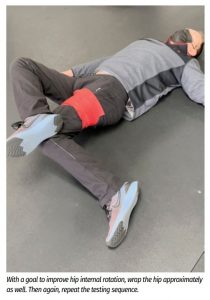
We must screen and assess to determine efficient energy transfer through the body. Gray Cook and Mike Boyle wrote an article that forever changed my practice and simplified my clinical care, “A Joint by Joint Approach.” In short, they described the body as a series of joints stacked on top of each other with alternating mobility and stability demands. Put simply, ankles, hips and thoracic spine segments need mobility. These are common segments in the body that are designed to be stiff, but then become overly stiff and can limit efficient movement.


Joints that become stiff don’t allow force to transfer through the segment efficiently and joints that become hypermobile don’t allow force to transfer effectively. Either of these problems leads to a breakdown in the kinetic chain, poor performance and increased injury risk.
Screening ankles, hips and thoracic segments for mobility and the best kinesiology tape applications


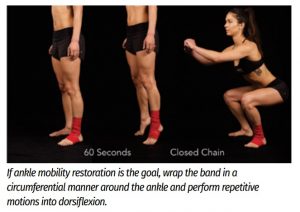
If ankle mobility restoration is the goal, wrap the band in a circumferential manner around the ankle and perform repetitive motions into dorsiflexion.
For thoracic mobility, using a floss band is also a great method to restore thoracic rotation. Apply the floss band around the trunk as shown below and then repeat the testing rotational position for multiple reps.

Screen the feet, knees, lumbar segments and shoulder for stability. Our foundational screen for these segments includes the following:
- Single leg balance for the feet
- Step-down height for the knee control
- Rolling pattern efficiently for lumbar control
- Single-arm front plank, 45 seconds, for shoulder stability
The mobility and stability of these key joint areas lead to optimal performance and injury prevention. If your client can successfully use these joints effectively, then they can have tremendous power production and success in kinetic linking. If they lack mobility or stability in the desired joint, then that must be addressed, or risk of injury will maintain above average and the client will never achieve max potential in the desired activity.
Recovery


Today’s science strongly supports that the most critical factor in high performance, overall health, is healing and sleep. The military and professional sports organizations have been focused heavily on this category for the past decade. Improving sleep duration and quality are the two largest factors in recovery.
An adult should be achieving a minimum of seven hours of sleep per night, whereas a teenager may require closer to nine hours. This must be our top priority when working with our clients on performance enhancement or injury prevention. All the physiological change we strive for in our treatment sessions is usually processed and takes full shape during sleep. If your client isn’t sleeping, it is all for nothing.
Tips for facilitating sleep
- Limit blue light 1-2 hours before bed. Blue light is from screens and it diminishes melatonin release and stimulates the brain in other areas, decreasing the likelihood of desired sleep.
- Match your sleep to the sun to maximize circadian rhythms. Make sure that your patients can see sunlight during the day, as it supports more natural sleep cycles and recovery.
- Modulate stress in authentic ways. Meditation is considered one of the most effective ways to manage effects of stress.
- Manage pain to maximize sleep. As health care providers we see this commonly, patients in pain who can’t sleep as a result.

In the evening and at night, as the person decreases their movement and activity, swelling begins to accumulate in an area, which creates increased pressure in the region, and then presents as pain in the body. Sometimes this happens right away in the evening before bedtime, or it often occurs a few hours into the night.
The best kinesiology tape applications for dealing with inflammation and swelling
Patients can avoid accumulated inflammation at night by anticipating it and properly using ice earlier in the evening. I advise patients to ice 15 minutes every two hours before bed to reduce inflammatory components and improve overall sleep.


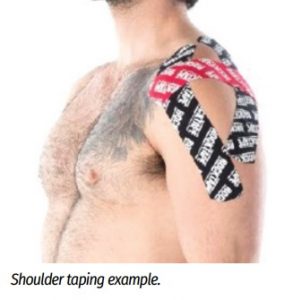
Local kinesiology taping can also be a great tool that can be worn at night to reduce pain and inflammation, leading toward better sleep, and is one of the best kinesiology tape applications for specific pain.
Develop regular screenings

Always consider sleep as a variable of recovery. It can be viewed cumulatively over a few days or weeks, and certainly just over one night of sleep. Both can lead to fatigue, decreased performance and increased injury risk.
TONY MIKLA, DPT, is a leading sports physical therapist, performance coach and researcher. He speaks and teaches nationally on sports physical therapy. He previously served as the physical therapy manager at the world-renowned EXOS in Phoenix, Ariz., and as a medical director for the Sacramento Sports Commission at Sacramento State University and Northern Arizona University. He is the founder and president of Kime Performance Institute, and in 2015 was a finalist for the NSCA Sports Medicine Specialist of the Year. He was awarded the 40 Under 40 Award from the Sacramento Business Journal in 2017. In addition to teaching for RockTape Functional Movement Training (FMT), most recently he developed the Bulletproof continuing education series for FMT+, including Bulletproof Spine, Bulletproof Shoulder and Bulletproof Knee.